Building Inspection vs Design-Led Assessment: What's the Difference?
You've found a property you love on the Northern Beaches. Your conveyancer says to get a building inspection. Your buyer's agent says you might want an architect to look at it too. Now you're not sure which one you actually need — or whether you need both.
It's a fair question, and the answer matters more than most buyers realise.
Standard building inspections and architect inspections are two very different things. They look at different aspects of a property, answer different questions, and serve different types of buyers. Choosing the wrong one — or skipping one you should have had — can cost you tens of thousands of dollars after you've already signed.
This guide explains exactly what each inspection covers, where the gaps are, and how to decide which one is right for your situation on the Northern Beaches.
What is a standard building inspection?
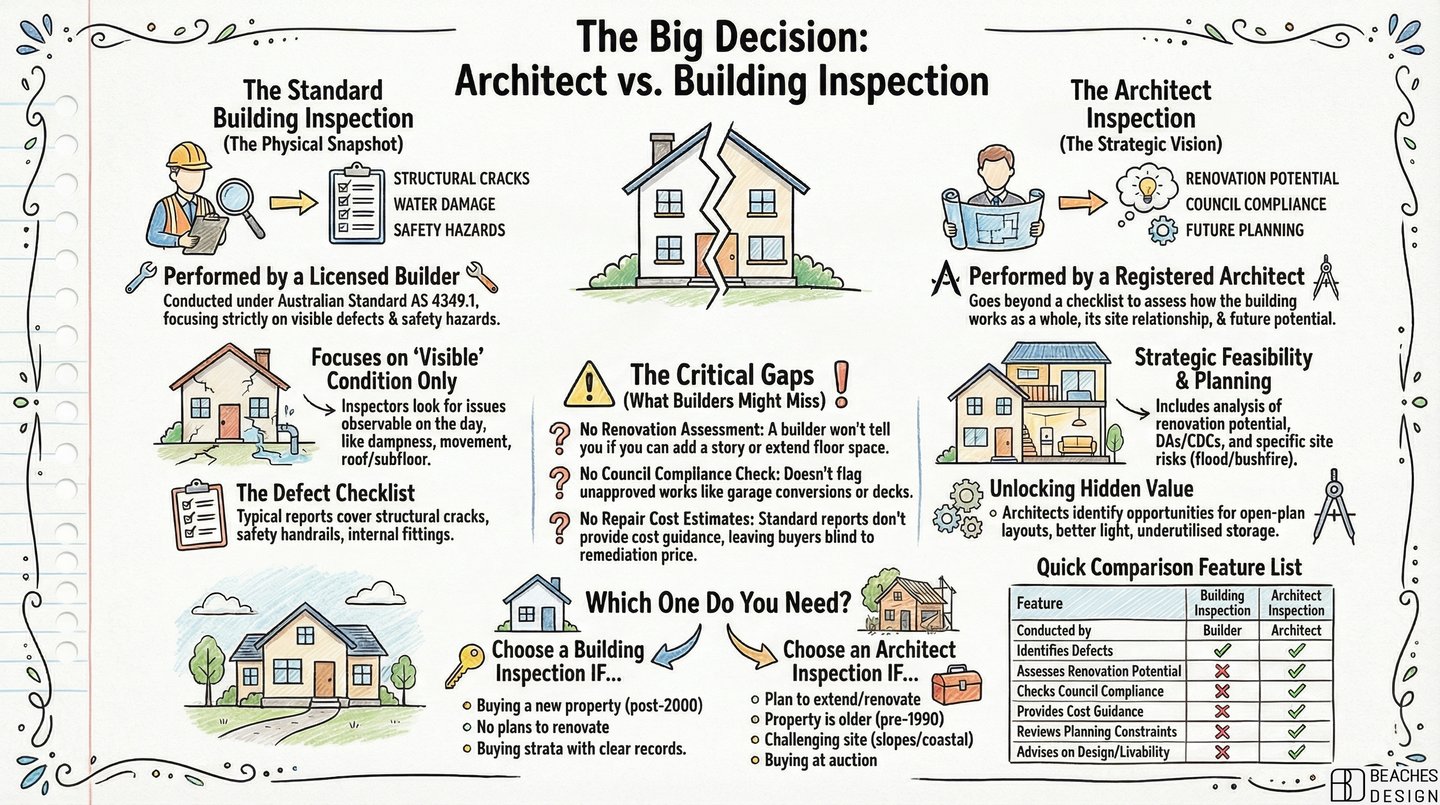
A standard pre-purchase building inspection is carried out by a licensed builder or building consultant. In NSW, the report must comply with Australian Standard AS 4349.1, which sets out minimum requirements for what gets inspected and how defects are reported.
A typical building inspection covers:
Visible structural defects such as cracks, movement, and subsidence
Roof condition (from ground level or accessible roof space)
Signs of water damage, damp, or rising moisture
Safety hazards including handrails, steps, and electrical meter boxes
Condition of floors, walls, ceilings, and internal fittings
Subfloor space where accessible
Garage, outbuildings, and retaining walls
The key word throughout is visible. A building inspector identifies defects that are observable on the day, documents them in a report, and hands it to you. That report is a snapshot of the property's physical condition.
What it is not is a guide to what the property could become, what it's worth fixing, or whether your plans for it are even feasible.
What is a design-led pre-purchase assessment?
A design-led pre-purchase assessment — sometimes called a renovation feasibility assessment or a pre-purchase design report — is carried out by a building designer rather than a building inspector. The difference in training is significant.
Where a building inspector is trained to assess how a property was constructed and whether defects are present, a building designer is trained to understand how a building works as a whole: its structure, its relationship to the site, its compliance history, and its potential.
A design-led assessment goes beyond defect-spotting to answer a different set of questions:
Renovation feasibility. Can this property be extended, reconfigured, or improved? What would be involved, and are there any planning or structural barriers?
Council compliance. Does the existing building comply with current approvals? Are there additions or alterations that were done without a DA or CDC? What is the risk to you as the incoming owner?
Structural assessment in context. Not just "there is a crack" but "this crack is caused by substandard footing design on a reactive clay site, and here is what remediation typically involves."
Renovation cost reality. If the property needs work, what is a realistic budget range? What are the hidden costs a buyer would face after settlement?
Flood, bushfire, and coastal risk overlays. On the Northern Beaches, many properties sit within flood zones, coastal erosion buffers, or bushfire attack level zones. These have direct implications for what you can build and insure.
Design and livability assessment. Is the layout functional? How would you improve it? Is the north-facing orientation being properly utilised?
A design-led assessment is strategic advice, not a defect checklist.
The critical gaps in a standard building inspection
Understanding what a standard building inspection is not required to cover helps explain why so many buyers are caught off guard after purchase.
1. It doesn't assess renovation potential
A standard building inspection will tell you the roof is in fair condition. It won't tell you whether you can raise the roof to add a second storey, or whether the block's FSR would allow you to. If you're buying with plans to extend, a building inspection leaves that entire question unanswered.
2. It doesn't identify unapproved building works
Building inspectors are not required to check council records. Unapproved additions — a garage conversion, an extended deck, a relocated bathroom — may be physically sound and entirely invisible in a building report. As the new owner, you inherit the compliance risk. On the Northern Beaches, where extensions and renovations are common and owner-builders are active, this is a real and frequent issue.
3. It doesn't include cost guidance
The AS 4349.1 standard explicitly states that building inspection reports do not need to include estimates of repair costs. Many don't. You can receive a report listing fifteen defects and have no idea whether you're looking at $8,000 in maintenance or $200,000 in structural remediation.
4. It may not address planning constraints
Whether a property falls within a heritage conservation area, a flood planning level, or a coastal management zone is not within the scope of a standard building inspection. On the Northern Beaches, these overlays are common and they significantly affect what you can do with a property.
5. It won't tell you if the property suits your vision
If your goal is to buy, renovate, and either live in or sell the improved property, a standard building inspection gives you almost no useful information about whether that goal is achievable. It tells you what exists. It doesn't tell you what's possible.
When a standard building inspection is enough
A standard building inspection is the right choice when:
You are buying a relatively new property (post-2000) in good condition
You have no plans to renovate or extend
You simply want to confirm there are no major structural surprises before exchange
You are buying a strata property and the building is managed by an owners corporation with recent maintenance records
In these situations, a licensed building inspector will efficiently give you the peace of mind you need. It's a cost-effective option when the scope of your due diligence is limited to: is this building sound as it stands?
When you need a design-led assessment
You need a design-led pre-purchase assessment when:
You're planning to renovate, extend, or reconfigure the property. If your purchase price is predicated on what the property could become, you need a proper design assessment of whether that vision is achievable — before you commit.
The property is older. Homes built before 1990 on the Northern Beaches often contain asbestos materials, pre-code structural work, and unapproved additions. An experienced designer's eye for compliance history and structural integrity in older construction is invaluable.
The property has had previous renovations. Renovations done without proper approval are common. If something looks newly built but doesn't appear on council records, that's a red flag an experienced designer is specifically trained to identify.
The block has challenging site conditions. Sloping blocks, proximity to waterways, bushfire zones, and coastal erosion buffers are endemic across the Northern Beaches. These all affect what you can build and how much it will cost. A building designer can assess these constraints in the context of
You want to understand true cost of ownership. If you're weighing up two or three properties and trying to understand which one represents the best value given renovation work required, a design-led assessment gives you the comparative intelligence to decide.
You're buying at auction. Auctions on the Northern Beaches are fast and unconditional. A design-led assessment before auction day means you go in knowing exactly what you're committing to.
Do you need both?
In some cases, yes — and they serve complementary purposes.
A combined approach works well when you're purchasing an older property with both defect risk (warranting a standard building inspection) and significant renovation intent (warranting a design assessment). Some firms, including Beaches Drafting, offer integrated assessments that combine defect identification with renovation feasibility in a single report.
If budget is a constraint, prioritise based on your goals. If your primary concern is defects on a newer home, a standard inspection is sufficient. If your primary concern is what you can do with the property, a design-led assessment delivers far more relevant intelligence.
Summary: building inspection vs design-led assessment at a glance
What about an architect inspection — do you need a registered architect?
Some buyers specifically search for an "architect inspection". It's worth being clear about what that means. In NSW, "architect" is a title restricted by law to those registered with the NSW Architects Registration Board, and a registered architect can certainly provide a pre-purchase assessment.
For most residential purchases, though, registration isn't what determines the quality of the advice — training and local planning knowledge are. What you actually need is someone who can read council controls, judge structural feasibility, and tell you honestly whether your plans for the property are realistic. Beaches Drafting is not a registered architecture practice; we're building designers with architectural training, and that is exactly the expertise this assessment calls for.
If your project genuinely requires a registered architect — a large new build, or a complex development where their statutory role matters — we'll tell you that plainly rather than take the work.
What to expect from a design-led pre-purchase assessment on the Northern Beaches
At Beaches Drafting, our pre-purchase assessments are carried out personally by Deon Du Plessis, an architecturally-focussed building designer with more than 20 years in professional architectural practices and deep familiarity with Northern Beaches Council planning controls, local construction typologies, and the site-specific challenges common across suburbs including Narrabeen, Collaroy and Mona Vale.
Our reports cover:
Structural condition assessment and defect identification
Unapproved works and council compliance review
Renovation and extension feasibility
Planning constraints including LEP provisions, heritage, flood, and coastal overlays
Indicative cost guidance for recommended works
Clear recommendations on whether to proceed, negotiate, or walk away
The outcome is not a list of defects. It's a clear picture of what you're buying, what it will cost you, and what it could become — so you can make the most informed decision of what is likely one of the largest purchases of your life.
Why This Matters on the Northern Beaches
Northern Beaches properties often include:
Older homes with multiple renovations over time
Coastal exposure and material deterioration
Sloping sites and drainage complexity
Extensions completed without proper structural consideration
Houses with strong renovation potential
Because of these factors, understanding both risks and opportunities before purchase is particularly important in this region.
How an Inspection Can Unlock Hidden Property Value
Many properties appear outdated or poorly configured but actually have strong underlying potential.
Building Designers are trained to see:
Layout Transformation Opportunities
A compartmentalised floor plan might be convertible into a modern open layout with minimal structural intervention.
Underutilised Spaces
Garages, subfloors, or storage areas may offer opportunities for conversion into valuable living space.
Extension Feasibility
Building designers can identify whether additions are likely achievable and what constraints might exist.
Improving Light and Orientation
Small changes to openings or circulation can dramatically improve perceived quality and value.
Future Renovation Staging
Building designers can help buyers plan improvements over time rather than all at once.
This type of insight is rarely provided in standard building inspection reports.
Avoiding Costly Planning Mistakes Early
One of the biggest financial risks when buying property is assuming renovations will be straightforward — only to discover constraints later.
Design-led assessments can help buyers avoid:
Purchasing homes that cannot be extended as expected
Underestimating structural complexity
Renovation budgets that escalate dramatically
Planning or approval limitations
Structural walls being removed incorrectly in past renovations
Hidden design flaws that limit improvement potential
Early architectural advice can prevent expensive surprises after settlement.
Final Thoughts
Buying property is one of the largest financial decisions most people make. Understanding both the risks and the opportunities before committing can significantly impact the outcome.
A building inspection helps you understand what might go wrong.
A design-led assessment helps you understand what could go right — and how to avoid costly mistakes along the way.
For buyers considering renovation, improvement, or value creation, early architectural advice can be one of the smartest investments you make before purchasing a property.